

This talk was given on Oct 8th, 2026 at Collegiate Reformed Fellowship, a ministry of Christ Church in Moscow, Idaho.
So great is the number of people that convert from RC and EO to the protestant faith everyday that it is hard to give clear stats about it. Precisely because so many people leave the RC faith to become evangelical is why when some few people leave protestantism to become RC, it hurts more. Our community and the culture at large has recently seen people moving to Roman Catholicism and to Eastern Orthodoxy. What motivates evangelical (even Reformed) Christians to Pope or to Orthopill? Scot McKnight interviewed many exvangelicals who Poped and came up with four rationales for why they do it. I think similar reasons could be made for Orthopilling. They are the desire to transcend..
1) The human limits of knowledge to find certainty
2) The human limits of temporality to find connection to the entire history of the church
3) The human limits of division among churches to find unity and universality
4) The human limits of interpretive diversity to find interpretive authority1
These may be clubbed under four heads certainty, catholicity, unity and authority. They are looking for certainty and authority in a pluralistic age. They longed for a sense of the unity of the church in space and time. They want a visible unmistakably manifest presence of the bride of Christ on earth as well as through history. These are good and admirable desires but RC and EO do not meet them any more than historic protestantism does. Moreover, in yielding to the enticements of these erroneous forms of Christianity, many Christians make shipwreck of their faith and of their lives. They deny the Gospel and neglect the very plain and manifest ways in which God wants to walk with us in this fallen world.
Quattuor Res Desideratae
It is certainly true that the modern world is facing a crisis of meaning. The kind of mathematical precision that modern man has come to expect in the realm of science and technology lacks the quality of the fullness that truth had when it was carefully preserved in the institutions and the psyche of medieval and ancient men. Whatever other problems they had, a postmodern hunkering after meaning was not one of them. Back then institutions were the God-given molds within which men were formed into what they were meant to be. Today, institutions are platforms for performance and self-expression. Moreover, trust in public institutions has tanked. The technocratic, financial, political and healthcare complexes continue to betray the trust of people in this country and in the West, in general. What is more? Truth has become a byword and an insult. Everyone has their own truth and if you question it, you’re a bigot. In a time like this, it is tempting to want to confide in an institution that makes fantastic claims about its certainty. The Bible has so many interpretations, the argument goes. God’s infallible word needs an infallible interpreter.
But what the seeking exvangelical wants in the Roman Catholic church won’t be found there. The same interpretive challenges that the protestant faces in the pages of Scirpture after going to meet him in the binding documents of the magisterium. Historic protestants gladly and wholeheartedly submit that the Bible isn’t a document that fell out of the sky and that most Christians are schooled in the doctrines of the faith in the context of the church. The question then is this—is the Bible sufficiently clear in its teaching about what is required of man for salvation? Can someone who knows any language in which the Bible has been translated read and understand in it the way that he is to be saved? And the answer is yes. For if the Bible is not clear and needs church documents to help interpret what it is saying, are the church documents sufficiently clear? Do they need another pair of glasses to interpret them? Ad infinitum. Who interprets the infallible interpreter? It really boils down to our doctrine of providence and our view of language. Does God exist and has He spoken clearly in His word? The Romanists deny this; we affirm it. But the same interpretive problems they throw at us with respect to the Bible meet them in the interpretation of their (equally authoritative according to them) tradition documents.
Moreover, there is no single collection of tradition that they can point to. It is not a written tradition that can be bound in a book but an implicit tradition which continues to unfold throughout history. The RCs are asking you to sign a blank check to whatever nebulous thing it is that the church has affirmed and whatever unknown things she will affirm in the future. It’s like institutionalized pentecostalism. We affirm continuing revelations from God, we don’t know what He will say next. This involves RCs in deep rabbit-trails to try to justify their positions. For example, Pope Honorius the First, who lived in the seventh century, was rightly condemned by a church council fifty years later as a heretic because he claimed that Jesus had one will (as opposed to two wills, which is the correct position). But then the First Vatican council, in the nineteenth century, established ex cathedra papal infallibility which said that whatever the Pope said ‘out of his chair’ was infallible. The RCs are embroiled in as much uncertainty and authority crisis as any other modern individual. The solution out of it is not to put our trust in Roman chariots or Byzantine horses but in God alone, who is the ruler of history and sends many trials to His people to refine their faith. You cannot escape the need to exercise faith by jumping ship to Rome.
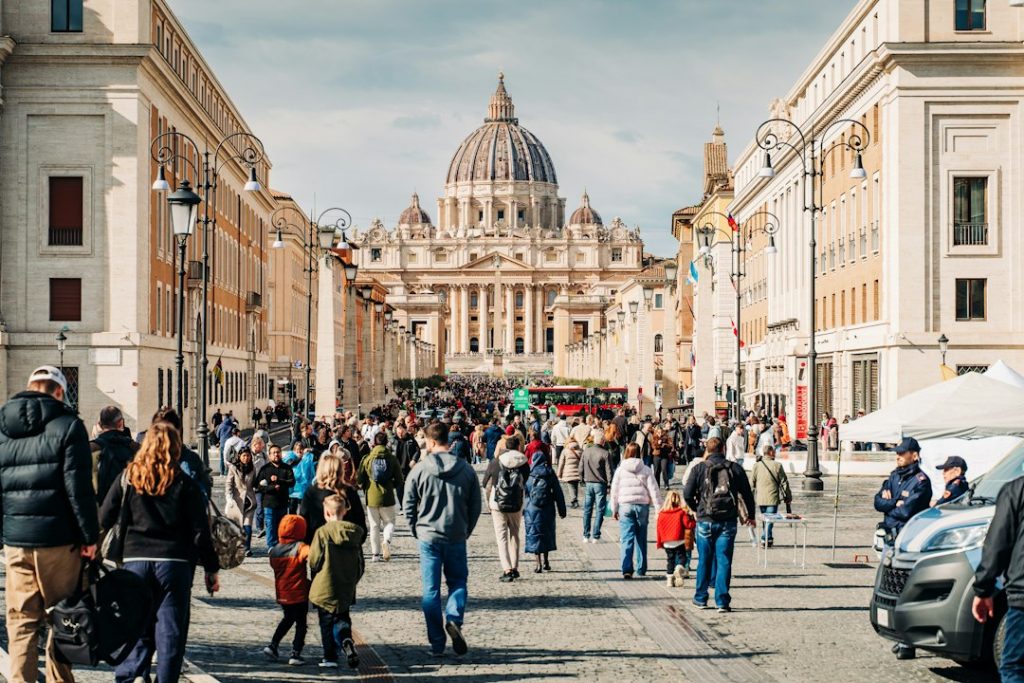
Likewise when the catholicity of the church is spoken about, Protestants have as much a belonging to the catholic church as the Romanists do. All the church fathers that they claim as their own (before the Reformation) we may claim as our own too. Our doctrine of the church does not require us to denounce those outside of our visible churches as outside the pale of Christendom. For Romanists, there is no salvation outside of the RCC (Unam Sanctam of Boniface VIII and the Council of Florence). Well, not quite. The Second Vatican Council (1960s) declared that “those who through no fault of their own do not know Christ or the Church, but seek God with a sincere heart, can attain eternal salvation.”2 This is another point where the RCC disagrees with itself. But the true church of Christ has consisted of all Christians and their children from Adam and Abel through to today. I am in fellowship with Augustine, Aquinas, Tertullian and all the rest despite all the disagreements I may have had with them if I had lived in their day being a Reformed protestant. I fail to see how the RCC gives people a sense of catholicity higher than the one that the protestant faith gives to them.
With respect to being very ancient, I contend that the RCC is younger than the Protestant Reformation. We celebrated the 500 years of the Reformation in 2017 AD. The Romanists may celebrate, if they wish, the 500th anniversary of the foundation of their church in about twenty years. It wasn’t till the Council of Trent in the 1540s-60s that the reformation Gospel heralded via the five reformation solas was first officially denounced. It wasn’t until then that the Apocrypha was officially declared to be part of Scripture. So the RCC was born thanks to the work of Luther and other reformers. In fact, the RCC is the largest protestant denomination in the world. Denominationalism, the tendency to view Christians as part of various overlaying communions is a very protestant and modern thing to do. If you call yourself a Roman Catholic (as opposed to an evangelical etc), congratulations! You just admitted to the legitimacy of what God did in the Reformation. And everything prior to that is the inheritance of protestants and RCs alike. Both traditions need to reject some parts of pre-Reformation tradition and accept other parts. But the true church consists of all believers who have existed since God made man. The Church is not someone’s private club. The Church has existed and organically grown since Adam and Eve.
Poking at the Heart
Having looked at the four reasons given by McKnight as to why people are poping, I want to give you some other reasons motivations and observation on all of this.
-
Evangelicals long for the aforementioned things and do not have a historically rooted protestant faith. They seem to have no options but to go full trad. But that does not account for those in CREC or other Reformed circles.
-
Being Catholic has become culturally cool. Matt Walsh is Catholic. Michael Knowles, J D Vance are Catholic. Mel Gibson, Jonathan Roumie and Jim Caviezel are Catholics. You can be Catholic and culturally acceptable to some degree.
-
It is a very unamerican thing to do. America was founded on Protestantism and shows. The life-blood of the people of this country is Protestant. Pastor Doug has talked about how the social imaginary of Americans is Calvinistic, Postmillennial and Evangelical Baptist. Historically, Americans have been suspicious of Catholic migrants due to their divided loyalty to Rome. I dare to notice that this suspicion has died down a fair bit. And for some good reason. American RCs (and EOs) are basically evangelicals. RCs from around the world are not like American RCs. Vandal Catholics use a form of the four spiritual laws. JD Vance did not kiss the ring of the Pope when he visited him. So becoming RC is going against the grain of who you are as an American.
-
In another sense, it is a very American thing to do. RC and EO conversions are Baptist-coded. In older, more covenantal, traditionalist times, no one would dare become RC out of the blue. If these people were true traditionalists (like modern Americans aren’t) they would have stayed with the religion of their grandma (which probably was bible-thumping evangelicalism). But they aren’t traditionalists! So they find no problem in hoping from one protestant denomination to another. It’s just a joyride going from church to church and state to state. EO is just the edgier, cooler sounding version of RC. RC is too mainstream.
-
Some of this is also being driven by the Jew-flu. As trust in institutions is tanking, people are losing their minds and beginning to trust no one. Being protestant means you are a Jew-lover. The Hebrew bible is no-go for me. Give me the Greek Septuagint. Here I come, RC. Historically, reformed Christians have been tolerant of Jews and this irks some people and they take their revenge by poping and poping hard.
-
I think a lot of this is escapism from real life responsibility and church accountability because you can be a member of a RC church and do whatever you want. If you want true authority, join a church that exercises right ecclesiastical discipline. A eucharistic group hug does no one any favours. A lot of what is driving this movement towards RC is a failure to own up to ones own sin and confessing it square in the face and receiving forgiveness from Jesus and energy to overcome that sin by the power of the Holy Spirit.
-
Ultimately both RC and EO are works based idolatrous religions that make people trust in their own devices rather than by the life transforming power of God. They are Christianized versions of the same impulse that exists in every fallen man to try to use self-effort to get right with God. If you are a RC in attendance and balk at this, I would submit to you that you have been severely affected by American evangelicalism and the doctrines of grace and are closer to your protestant brethren in attendance than most RCs around the world today.
-
Lastly, being postmillennial, we await the day when Vatican will confess her arrogance and pride in believing that she can stand in God’s blessing because of her own good works and special favour. Vatican will repent and believe in the Gospel and be grafted back into the true vine which she had been grafted into by God. God wrote to the church at Rome reminding them that the root bears them up and not the other way. If they pride themselves in being grafted into God’s vine, they will be cast off. But behold the goodness and severity of God! The same God who casted off the Jews and has promised that they will return is the same God who has promised to be merciful to all His children to a thousand generations. If he can graft the Jews back in, He can graft the papists back in too. For that we pray and labour.
Scot McKnight, “From Wheaton to Rome: Why Evangelicals Become Roman Catholic,” Journal of the Evangelical Theological Society 45, no. 3 (2002): 451–472.
Lumen Gentium (para 16).
Originally published on The Flying Scroll.
 New release
Gloria in Excelsis Deo
In Excelsis Deo is an Advent devotional for those who wish to remember why. Each day begins with an old carol or hymn, because some truths…
Browse the bookstore →
Leave a comment
Please log in to join the conversation — it's free. Don't have an account? Join here.