
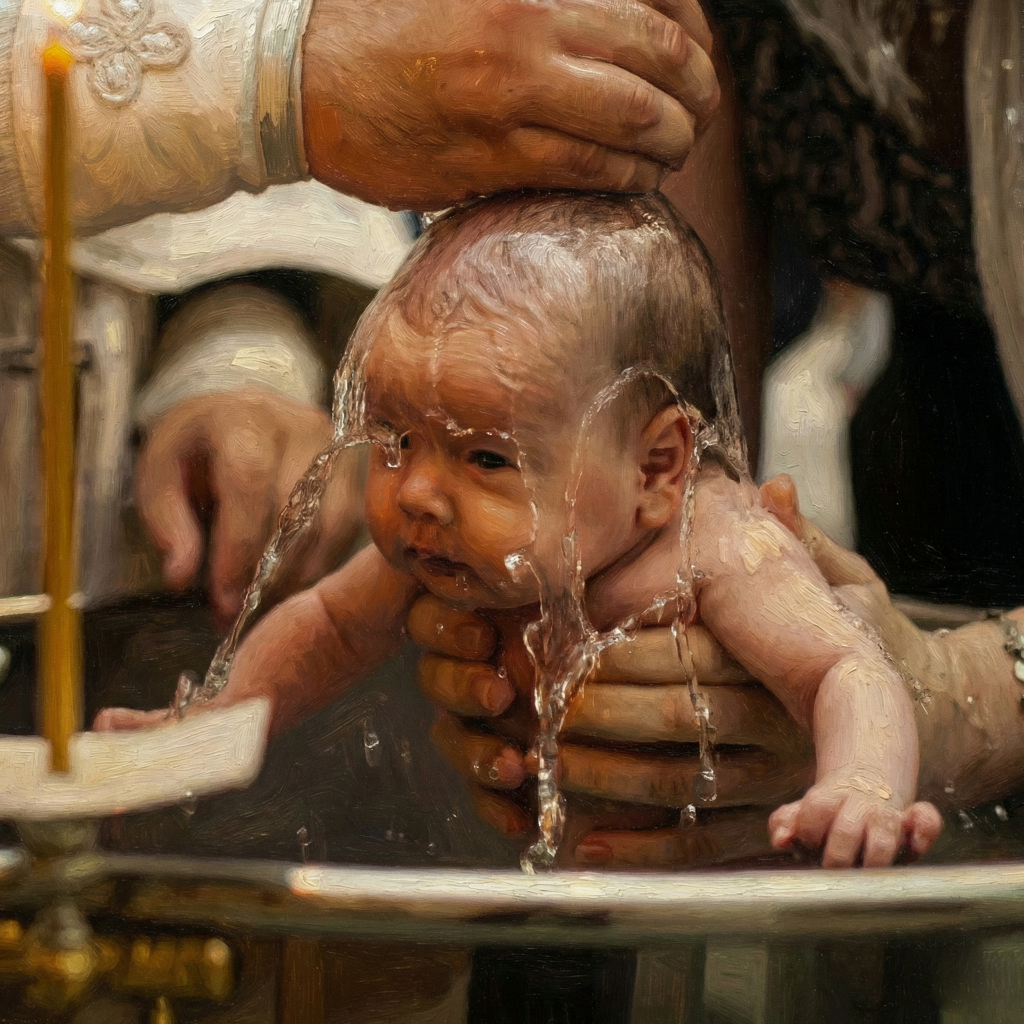
The topic of baptism is a vast one, much larger than many make it out to be. If you look at the New Testament, and particularly the book of Acts, we find the first generation of believing Christians being baptized and added to the Church. In a similar fashion, if an unbaptized person comes to faith at some point in their life, there is no debate on whether or not they should be administered baptism. What we see Christians debate is whether or not the child of believing, baptized parents should be baptized. In the NT, we do not see a specific record of an infant baptized at birth, nor do we see the child of believing parents grow up to a certain age before confessing Christ and getting baptized. What we do have in the book of Acts is the incident of a household getting baptized.
Baptists and other credo-baptists (Christians who administer baptism only to those who have repented of their sins and confessed faith in Christ) would say that “household” here is an umbrella term used by Luke to refer only to non-infants. This kind of baptism occurs repeatedly in Acts, such as the cases of Lydia (Acts 16:15), the Philippian Jailer (Acts 16:33), Crispus (Acts 18:8), and Cornelius (Acts 10:47–48). The paedo-baptists (those who baptize infants of believing parents in addition to confessing believers) would argue that the “households” in the texts actually mean the entire household, including infants. But these arguments do not take us anywhere in and of themselves.
In order to understand baptism, we have to study the framework in which baptism sits within Scripture and the assumptions the NT authors make when they write. The NT authors were not 20th or 21st-century American or European scholars. They were not pagans finding Christianity and figuring it out from scratch, but Jewish authors who had thousands of years of passed-down heritage and a cultural understanding of sacraments and covenants in a much more experiential sense than we moderns may ever have. We see the New Covenant and are tempted to use a surgical knife to rift a divide between the old and new, because what is “New,” after all, if not absolute discontinuity? But this comes in contrast with the words of Jesus himself, who says that he had not come to abolish the law and the prophets which are the covenant documents of the old covenant, but to fulfill them (Matthew 5:17). In fact, we find many in Jesus’ time having this same confusion regarding an absolute cut-off. As he was building the new covenant community and explaining the true heart behind the moral law, he clarifies that he has not come to abolish what was there formerly by saying, “Do not think…”
Covenant Continuity
Our discussion about baptism cannot be had without discussing the Abrahamic covenant first. We will focus on the following aspects: whom the promises of the covenant are for, what the sign is, and what the “expiry date” on the covenant is. Genesis 17:7–9 gives us the following information: (i) the covenant beneficiaries are Abraham and his descendants, (ii) Abraham and all his male descendants have to be circumcised, and (iii) the covenant is an everlasting covenant. Let us focus on the “everlasting” aspect first. How can an everlasting covenant end? It cannot. In which case, does it continue today? If it does, does it continue in the exact same form?
When Jeremiah and Ezekiel promise the New Covenant, the promises to the children are seen to echo the Abrahamic language: “And I will give them one heart and one way… for the good of them and their children after them” (Jeremiah 32:39). When the New Covenant is inaugurated, we find Peter taking these promises and applying them immediately. At the temple in Jerusalem, he iterates to the Jewish people how the promises are to them and their children, extending these promises by saying it is also to “those who are far off” and “everyone whom the Lord our God calls” (Acts 2:39). This shows that instead of an absolute replacement of the promises to Abraham, they have been expanded and made better and bigger in the New Covenant. Furthermore, Paul explains how the true heir of the Abrahamic covenant is Christ (Galatians 3:16), showing the fulfillment of the Abrahamic Covenant in Jesus, i.e., the New Covenant.
To further speak to the continuity of the covenants, let us see how the NT authors use OT covenants in their discourse to the church. Paul tells the Roman church how they have been grafted into the same Olive tree that the Jews were part of in Romans 11:17–24. The olive tree is used repeatedly in the OT for covenant imagery (Jeremiah 11:16, Hosea 14:6). Paul shows us how the Gentiles, who are from a “wild olive” (one not tended to by God) are grafted into the tree God had cultivated. The original branches (unbelieving Jews) are cut off, and the Gentiles are grafted in. Notice again: it is not a different olive tree altogether, but the same tree with new branches grafted in. Paul also warns that the same stipulations of being cut off for unfaithfulness remain for the newly grafted Gentiles.
When the New Covenant is promised, it does not come with a new set of statutes but an ability to keep the law by the aid of the Spirit. Jeremiah 31:33 says, “I will put My law in their minds and inscribe it on their hearts.” The law here is the Law handed to Moses, not a new law. Likewise, Ezekiel 36:27 says, “I will put My Spirit within you and cause you to walk in My statutes and to carefully observe My ordinances.” It does not say “future” statutes, but the existing ones.
I do not think any passage is as explicit as 1 Corinthians 10:1–12 when it comes to covenant continuity. Look at the way the Apostle Paul easily goes back and forth between the Old and New covenants. To the Gentile Christians, Paul says “our fathers were all under the cloud” (v. 1). “Our fathers”? Very casually, the Gentile Christians are being counted as the descendants of the Israelites – not by the flesh, but by covenant. Paul then retroactively applies the Christian ordinance of baptism to the Jewish forefathers: they were “baptized into Moses in the cloud and in the sea” (v. 2). Then come the heavy statements: “They all ate the same spiritual food and drank the same spiritual drink” (vv. 3–4). This language of “spiritual food and drink” is not accidental, as Paul discusses the Lord’s Supper later in the same context. Further, it says the rock they drank from was Christ himself. The people of the Old Covenant were sacramentally connected to Christ.
Paul argues that God was not pleased with most of them. It is vital to notice that the sacraments were not administered because everyone was genuinely regenerated, but because they were part of the covenant. Then, in verse 11, comes the warning: these things happened to the Israelites as a warning and example for the Church. Paul’s argument is: “Want to know how God deals with the people of the New Covenant? Look at the people of the Old Covenant who ate and drank of the same Christ and were symbolically baptized.“ This shows massive continuity.
The Case for Infant Baptism
Circumcision was administered to the Covenant People of God. Paul tells the Ephesian church: “remember that at that time you were separate from Christ, excluded from the commonwealth of Israel and strangers to the covenants of promise…” (Ephesians 2:12). Separation from the nation of Israel meant separation from Christ. As established, these people were required to administer circumcision to their children because the Abrahamic covenant was for them and their descendants.
What does that mean for baptism? Romans 4:11 tells us that circumcision is the “seal and sign” of righteousness. Colossians 2:11–12 further links the two, calling baptism the “circumcision of Christ.” Baptism is presented here as the New Covenant counterpart to circumcision.
Now the question remains: there was a covenant people, and there remains a covenant people. Both have blessings and severe warnings of apostasy; both have promises to the people and their children. Romans 4:11 also clarifies that circumcision was not the seal and sign of a righteousness of faith that the individual Israelites inherently possessed, but a righteousness that Abraham had. It was a seal of the promise that the descendants of Abraham received. Similarly, baptism is the seal and sign of the New Covenant. Here, the “righteousness of faith” is not the righteousness of the child, but that of Christ. In Christ, the covenant is not less inclusive; it is more. It is for you and your children, and to those far off; the sign is no longer restricted to male descendants but is for females alike.
1 Corinthians 7:14 even states that the children born to a believing parent are “holy.” The logical conclusion is to administer the sacrament that is due to the children of the New Covenant. We need to baptize them. We must hold on to the promises of God’s faithfulness to the generations of believers and add our children sacramentally to the covenant community of God. Baptism is not an individual expression of faith, but the sign and seal of our ingrafting (as seen in the Olive Tree of Romans 11) into Christ.
So go ahead, Christian parents. Baptize your little ones. Don’t look at the fragile cries of your infants or the tantrums of your toddlers for validation. Instead, look to our Savior Christ and his everlasting, unmoved, unchanging promises (Hebrews 6:13–18).
“But the steadfast love of the Lord is from everlasting to everlasting on those who fear him, and his righteousness to children’s children.” – Psalm 103:17
Originally published on True Doxology.
 New release
Gloria in Excelsis Deo
Once upon a time, the Maker of mountains and oceans, of stars and sparrows, entered the world He had made. The hands that hung the heavens…
Browse the bookstore →
Leave a comment
Please log in to join the conversation — it's free. Don't have an account? Join here.