
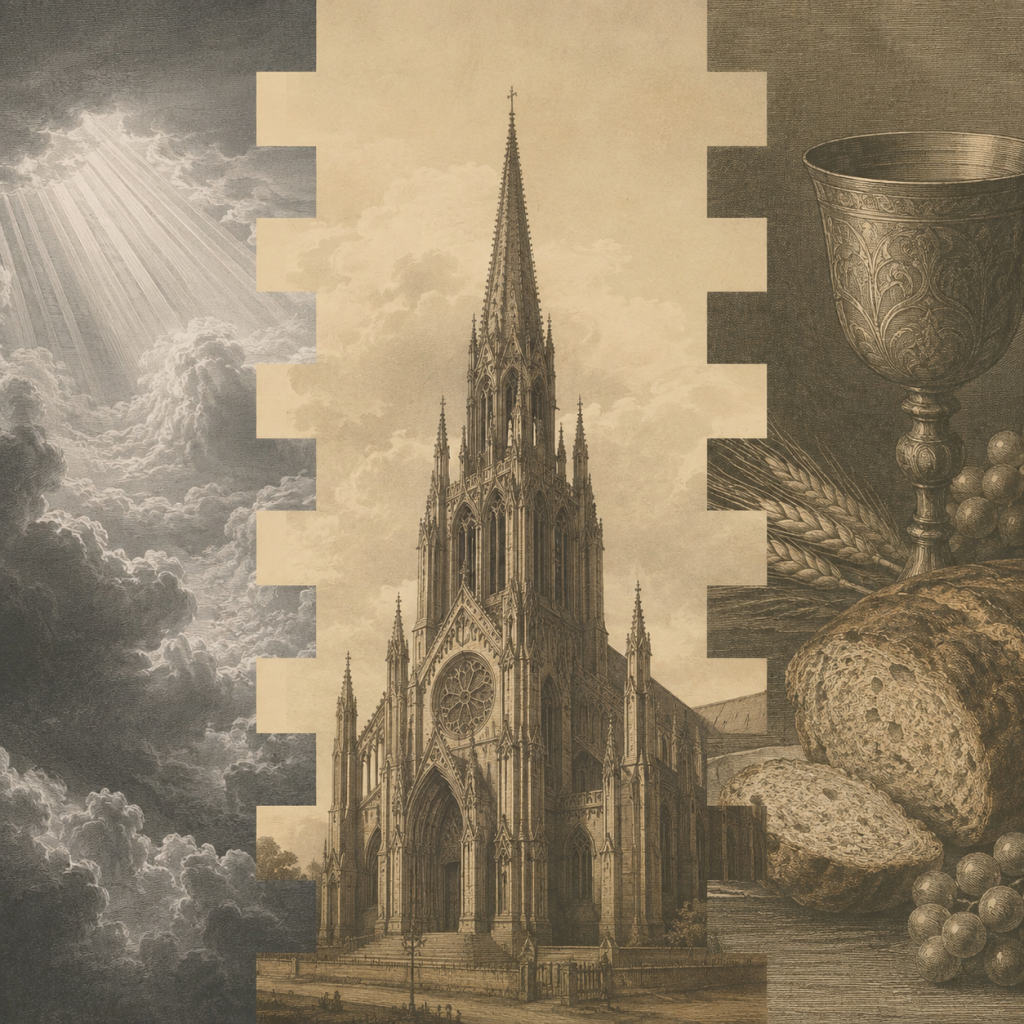
I’m not sure if this is the most apt title for the article. It’s almost like I have picked the most recurring words from my article and stitched them together into a title. My premise is that our polity affects more than just voting rights and exercise of the keys to the kingdom.
Polity has its effects on the architecture of the church building, the clothes worn by the elders, the decoration on the walls and to use a Gen-Z word – the general vibe of the church. One could perhaps identify a correlation-causation fallacy in my argumentation and point it out in the comments and I’ll be open to it. This is not one of those Contra Mundum type of issues.
The priesthood of the believers in New Testament is a very biblical idea (1 Peter 2:5 ) but in what way has also to be understood rightly. If left unhinged, it can flatten the priestliness of the office of the elders to just glorified counsellors. Pastor becomes a bro and Lord’s supper is replaced by crackers and grape juice that dads can give out to kids during online services.
The more one flattens the office of the minister, the more one diminishes the value of typology and symbolism. The scripture shows us that worship always ascends. God is in the heavenly places and all consecrated things journey upwards. Incense, burnt offerings, lifted hands and erected altars (Exodus 29:18; Leviticus 1:9; Hebrews 9:23–24). In the New covenant dead sacrifices are replaced by living sacrifices who live as burnt offerings and their offerings of praise and worship ascend producing a sweet aroma in God’s throne room.
The priestliness of the saints ought to elevate them to see the heavenly in all hierarchies and orders and symbols by bringing them closer to the heavenly realities (Colossians 3:1–2; Hebrews 12:22–24) . But if it is understood as mere generalizing of the office, then all hierarchies get flattened and the congregation loses the sight of the heavenly in the material things.
Even those with good intentions who remove the elevated dais in the church to imply that worship is not a stage performance fail to see that the dais is symbolizing not a stage but a Holy place where the burnt offerings (songs of worship), Word and sacrament are administered.
Same goes for the architecture of church. The steeples of the churches pointed up towards the heavens back in the day. But now the church buildings are built more with the intention of serving the utility of people. Churches are built like malls or government offices where utility or getting stuff done is prioritized more above everything. Church building ought to represent the nature of God and not the nature of man. Instead of looking heavenly and ethereal they are built more in line with what’s trending on the latest architecture magazines.
There is a danger of unhinged thinking in the other direction too. How priestly is the elder? How about we make one elder more priestly than the other? How about we have a super priest in a region and call him a bishop and give him bigger cloaks and shiny rods to assert his greater priestliness? How about there’s one mega priest above everything and we call him the pope and give him a magnificent hat to stand out among all the other hierarchies. You see where I am going with this?
We have entire cities like Vatican that has some of the most beautiful artwork and symbolism in the entire world but is yet spiritually dead. But as protestants we are not to do the opposite of what the Roman Catholics or some Eastern churches do, but instead do what the bible asks us to do.
As priests of the New Covenant, the congregation should train to develop a taste to see the heavenly in the material. Elders are to train the church to do this with discernment. Our church buildings and houses should be full of symbolism that develops a taste in us for the heavenlies. The heavenly things are beautiful and we need to display that beauty to the people around as citizen of heaven.
In the post modern world all thought is convoluted, and man-centered. We live in a clown world where everyone tries to normalize the absurd. We can stick a banana to the wall with a duct tape and men will spend hours looking at it in an art gallery. Paintings look messy like someone tumbled over a bucket of paint and it spilled on the canvas. Though the paintings themselves are great reflections of the mess in the minds of the painters behind them. When church buildings are built, often the planning goes only into parking spaces and coffee machines. Even reformed churches that preach against consumerism and the service being centered around Christ should stop and think if their church hall makes it look like a place built to serve them.
This has its effects on all kinds of things. Clothing, demeanor, what congregational singing looks like – all of it. When picking clothes for a Sunday morning, when sharing testimonies in the congregation, the way we carry ourselves all have to reflect the heavenlies. Now a push back to this that I can expect in this day and age is that wouldn’t that make the church no different from those old traditional churches that have beautiful symbolism but most people are spiritually dead? To which, the answer is simple. Don’t be spiritually dead. Of course the elders are to keep preaching hot gospel from the pulpit and calling men and women to obedience.
Somehow people assume that adopting one means having to let go of the other. Also, it is misleading to say God just wants us to be authentic. It is more appropriate to say that you are not supposed to lie about your spiritual status before God and should be open about your sin so that you can receive pardon. But the same way it is common sense to not show up for a funeral in a cocktail dress, it is not sensible to show up to church looking casual.
The heavenly chorus sings praises about the chief shepherd Christ who is seated before them. The elders likewise who are under shepherds stand at the holy place and lead the congregation to praise the chief shepherd as one voice (Acts 20:28; 1 Peter 5:1–4) . Throughout the service they see the elders administer grace to them as priests on behalf of the high priest Jesus Christ. The elevated dais, the centrality of the pulpit from where the word and sacraments are administered – all act as a microcosm of the heavenly Holy of Holies.
The material anticipates the spiritual. Symbolism when done by redeemed men is a very spiritual thing. But it gets often associated only to outright Pharisaism. Sin is like a parasite, it needs a host to survive. Similarly, sin can latch on to good symbolism and corrupt it. Symbols lose their value when men lose sight of God. But the folly of man is to think that symbols are the issue. The issue was, is and always will be man. Hence all the more need to use symbolism rightly to train the hearts of men.
Originally published on True Doxology.
 New release
Gloria in Excelsis Deo
In Excelsis Deo is an Advent devotional for those who wish to remember why. Each day begins with an old carol or hymn, because some truths…
Browse the bookstore →
Leave a comment
Please log in to join the conversation — it's free. Don't have an account? Join here.